
Details
ISBN/EAN: 978-3-95829-622-0
Einband: gebundenes Buch
Weitere Details
Auflage:
1. Auflage 2026
1. Auflage 2026
Erschienen am:
27.05.2026
27.05.2026
Sprache:
English
English
Umfang:
328 S.
328 S.
Hersteller:
Steidl Verlag
mwegener@steidl.de
Düstere Str. 4
DE 37073 Göttingen
Steidl Verlag
mwegener@steidl.de
Düstere Str. 4
DE 37073 Göttingen
Weitere Details
arrow_forward_ios

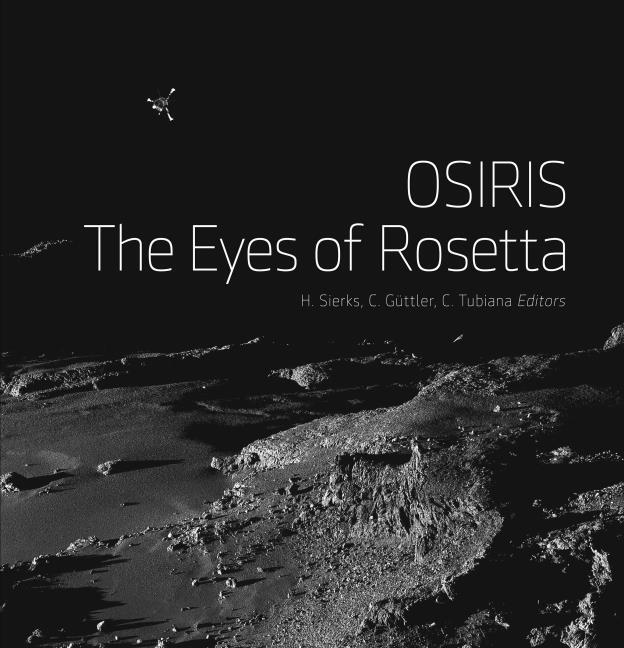
OSIRIS - The Eyes of Rosetta
Journey to Comet 67P, a Witness to the Birth of Our Solar System
Beschreibung
Comets as beautiful phenomena in the night sky have fascinated humans and inspired our imagination for millennia. Having witnessed the formation of our solar system 4.6 billion years ago, comets are also a scientists dream to study. Composed of fluffy dust, several ices and rich organics, it has long been believed that they preserve pristine material from this early time and therefore hold the key to understanding the origin of the solar system with all its planetsand ultimately life. To make this dream a reality, the Rosetta mission visited a comet named 67P/Churyumov-Gerasimenko between 2014 and 2016. On board the orbiting Rosetta spacecraft were eleven scientific instruments as well as Philae, an in situ laboratory to land on the comets surface. The camera system OSIRIS (Optical, Spectroscopic and Infrared Remote Imaging System) can certainly be considered the Eyes of Rosetta. This book collects the most stunning images acquired by OSIRIS and compiled by the scientists who were responsible for the development and operation of the camera system. From the launch of the Rosetta spacecraft on board an Ariane 5 rocket, to a journey through space of more than ten years to reach 67P/Churyumov-Gerasimenko, OSIRIS - The Eyes of Rosetta allows us to explore a comet with our own eyes and discover how exotic yet oddly familiar it is.
Über Holger Sierks, Carsten Güttler, Cecilia Tubiana
Holger Sierks, Carsten Güttler and Cecilia Tubiana of the Max Planck Institute for Solar System Research in Göttingen represent the team of scientists and engineers that built and operated OSIRIS. It took more than 30 years of planning, construction and travel for OSIRIS to finally reach comet 67P.


